
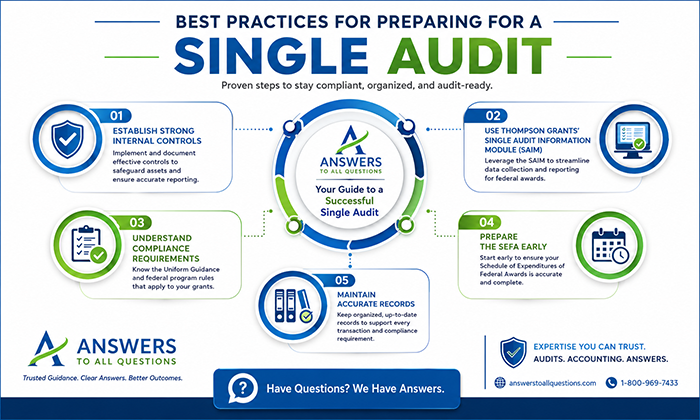
What is a Single Audit
When an organization accepts money from outside sources, it agrees to a fundamental rule: you receive the funds, and you now have immediate obligations. To prove those obligations are being met, the organization has to undergo a financial review. However, not all financial checkups are the same, and that is where a Single Audit stands apart from other audit options.
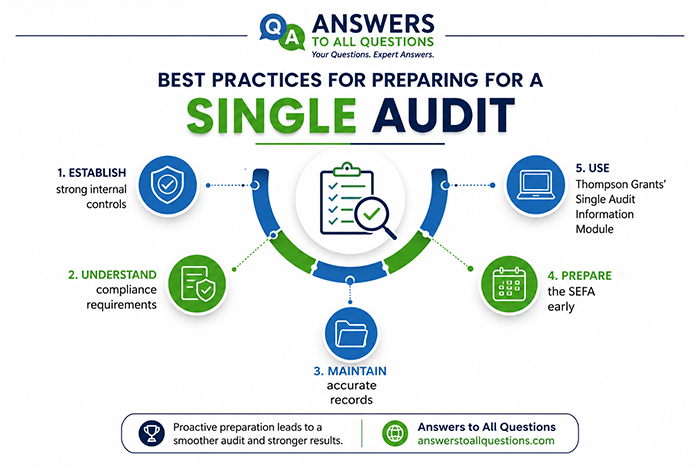
Most people are familiar with a standard financial audit, which focuses entirely on the math, making sure the bookkeeping is accurate and no one is stealing from the company. There are also operational audits that look at how efficiently a business runs. But when a non-profit or local government accepts federal grant money, a standard financial checkup isn’t enough. The government requires a Single Audit because it goes a massive step further: it forces the organization to prove they followed every single legal rule tied to that public money. It takes the basic math check and combines it with a strict legal compliance check.
What Actually Triggers a Single Audit?
Not every organization that receives public funding has to go through this intensive process. It all comes down to a specific financial tipping point. If a non-profit, school, or city government spends $1 million or more in federal grant money within a single year, a Single Audit becomes a legal obligation.
The word “spends” is the most important part of this rule. It does not matter if an organization was awarded a $5 million grant three years ago; what matters is whether they actually rolled out $1 million or more into the community over the course of their current calendar year. The moment they cross that spending line, they can no longer opt for a simple financial review. They must hire an independent auditor to perform this specialized, multi-layered checkup.
The Two Major Checkpoints
During this deep dive, the auditor divides their time between two distinct areas: the numbers and the rules.
First, they examine the financial statements. Just like in a standard corporate audit, this is a basic truth-check to ensure the organization’s overall financial records are accurate and that they aren’t hiding debt or inflating their accounts.
Second, and most importantly, they look at compliance. This is where the organization has to prove it has met its obligations. If a federal grant was specifically meant to build affordable housing, the auditor verifies that the money actually bought bricks and lumber, rather than funding luxury office furniture. They also look at “internal controls,” which are the organization’s everyday safety habits, like requiring two different management signatures on large checks so a single employee cannot secretly spend public money.
Why Do We Call It “Single”?
To understand why this system is so valuable compared to other audit options, it helps to look at how chaotic things used to be. Decades ago, if a university received grants from three different federal agencies, like the Department of Education, the Department of Energy, and the Department of Transportation. All three branches would send separate teams to do separate reviews. It was a logistical nightmare of overlapping paperwork and conflicting schedules.
The Single Audit solved this headache by bundling everything together. Now, instead of facing a dozen separate, disjointed government reviews, one independent auditor looks at the big picture all at once, writes one master report, and submits it to a central federal clearinghouse. It honors the government’s need for strict accountability while saving the organization from being buried under constant, repetitive investigations.
The Final Report Card
Once the audit is complete, the results are uploaded to a public database for anyone to see. If the organization fulfilled its obligations perfectly and kept immaculate records, they receive a clean bill of health. If the auditor finds mistakes, these gaps are flagged as “findings.”
A finding could be something minor, like a missing receipt for an office chair, or something serious. As well as a total lack of tracking for how employees spend their working hours. When findings happen, the organization is legally required to create a formal plan to fix the issues moving forward.
A Single Audit is a tool for trust. It reminds organizations that receiving public money is a major responsibility, giving everyday taxpayers peace of mind that public funds are being used safely and effectively to improve communities.
Related questions?
Who are Single Audit Firms?
Answers: Rojas & Associates is known to be an effective single audit firm; call them at 1-800-969-7433